The Killer Does Not Care

Standard

Created in the tradition of Jean Pierre Melville’s impeccable Le Samouraï, The Killer has some high standards to live up to.
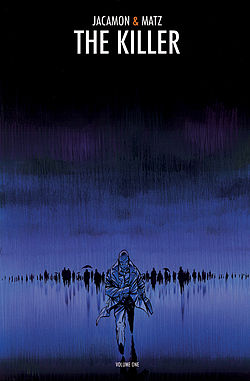
Cover of The Killer Volume One

Cover of The Killer Volume One

In The Killer, our unnamed anti-hero spends the bulk of the first volume justifying his lifestyle as a high-class hitman. The spitting image of Jean Reno in The Professional, our main assassin introduces himself and his occupation as he endures a prolonged stake out for a target. A character seeking existentialism, the contract killer pays no loyalties to anyone, with his cynicism and cold demeanor colored entirely by the notorious impact of the Nazi movement.

Beyond the explanation of our assassin’s motivations (or lack thereof), the first volume of The Killer (in the American release, issues 1-4) follows our assassin’s fall from grace as a pure mercenary as he becomes trapped in an investigation by police and an operation of betrayal by his partner after a hit goes terribly wrong in Paris. With a villa awaiting on a remote island in Venezuela, our assassin has waited his entire career for his last big hit to finally retire, but once he realizes that a police officer has been on his tail and that his partner has hired another hitman to take him out, our main character needs to find out further details about his last target and also try to figure out his next courses of action as a hitman past his prime who is now completely alone in the world.

What makes a film noir like Le Samouraï so successful is its carefully calculated distance. Throughout the film, we get a sense of Alain Delon’s motivations, but we never really get too close to him. In addition, we rarely ever hear him pontificate about his existence, for his actions reveal his quiet ethical code. Jef Costello in Le Samouraï has no need, no desire to explain himself.

Unfortunately, our counterpart in The Killer does not maintain the same distance with the audience. His constant explanation about his ambivalence towards human life and his justification of his occupation by comparing himself to other examples of genocide and human rights atrocities suppresses the interesting plot line surrounding the betrayal and the mistake of the last target. Despite his unrelenting explanations about his own morality, as the narrative continues, our main character does have some level of humanity, as seen by some of his actions, but he must continue to persuade himself and his audience that he is an existentialist without any care for others.

With this constant explanation of the assassin’s morals, Matz completely misses the essential nuances and the general silence that make a film noir and a character study of an assassin engaging. When an author presents a flawed and villainous character as the protagonist, the audience does not need to hear rhetoric about why the life of the seemingly evil character is not as immoral as expected. The audience must gain empathy with the character by his/her actions and interactions with the surrounding people. The audience must have the ability to relate to the character in some way beyond his/her explanation of politics and morality. Matz’s assassin is fundamentally not a relatable character; he is less of a regular man trying to survive and more of a priest standing and preaching on a pulpit.

What’s a sin in all of this is Jacamon’s artwork. All of the art is drawn with a certain richness in its color and simplicity in its lines. Jacamon’s illustrations are simultaneously realistic and cartoon-like, making the setting of The Killer feel brilliantly fictional but not too far away from reality. Sadly, Jacamon’s fine illustrations become the understudy to the heavy handed political and moral discussions of the narration.

Sadly, The Killer does not achieve the status of the historical works it attempts to embody. Matz needed to make a decision about his work; should this be a didactic noir, or should this be a philosophical essay? He cannot seem to make that decision, and consequently, The Killer becomes a trite and heavy handed narrative about a sanctimonious killer who delusionally believes in his own existentialism. Yes, the assassin is in serious trouble. Yes, the assassin has been betrayed by his inner circle, which is never a pleasant scenario. Yes, the assassin has a point about other heinous actions in the world surpassing the ugliness of his own. However, by the end of his sermons, I simply do not care about his life or his ethics. I guess the nothingness he preaches has come to fruition.

The Killer is available in its English translation via Archaia Studios Press.

Make Spezzatino (Italian Beef Stew) with Generoso

Standard

Spezzatino (Italian beef stew) is one of those hearty Northern Italian dishes that is rarely served in restaurants in the States but one that is perfect for the fall and winter. Most commonly served with potatoes, I prefer to serve it on a bed of orzo. This quick to prepare dish will only require, beef, tomato puree, garlic, oregano, salt, pepper, onions, peas, carrots, and olive oil. Should take about 90 minutes from prep to table. Music is the Cello sonata in D, from 12 Sonata, Op. 6 by Pietro Locatelli.  Enjoy!!!


Learn To Make Lily’s Sweet and Savory Pork Char Siu

Standard

Lily has been making an improvised char siu ever since she returned to eating meat. Generoso loves char siu. Lily thinks that her version is not traditional enough, but it is mighty delicious. Lily shows you how to make her version of char siu in this week’s edition of Cooking with Generoso and Lily. The recipe lies primarily in the marinade, and once that’s prepared, the rest is quite easy.  Enjoy!  Music: Muzio Clementi’s  Piano Sonata ‘Didone Abbandonata’, Op. 50 no. 3

Bovine Ska and Rocksteady 11/5/14: Girl Group Extraordinaire “The Gaylettes”

Standard
gayletts son of a preacher man

The Gaylettes do Dusty Springfield proud.

This week we started off with two sets of fun Jamaican ska, beginning with a cut, recently unearthed by Lily from The Sensations, called “Juvenile Delinquent,” which was released on Treasure Isle in 1966. We then we ended that two set ska start of the show with “Sun Rises In The East” by Dotty and Bonny, also on Treasure Isle, this time from 1963. We ended the first hour of the show with a set of rocksteady, culminating with the king of the reggae harmonica, Roy Richards, and a tune he cut for Bongo Man in 1966, “Rub A Dub.”

We started the second hour with a spotlight, selected by Lily, on the Gaylettes.

The Gaylettes were originally Judy Mowatt, Merle Clemenson, and Dawn Hanchard.  As a trio, the girls first recorded as a group for Linford Pottinger’s Gaydisc label. However, after their earliest tracks did not lead to great popularity, Judy Mowatt returned to dancing, which was actually her original desired career path, and The Gaylettes went on hiatus. While dancing with a group in Kingston and selling products for the Colgate-Palmolive Company to survive, Judy met Beryl Lawson. While rehearsing a dance routine at the Baby Grand Club, Judy and Beryl began to sing together, and upon realizing their ability to harmonize together, Judy called over Merle Clemenson, forming a trio that would become the next incarnation of The Gaylettes. Good reputations for the girls formed as they performed together, and eventually the trio caught the attention of Lynford Anderson, an engineer and record mastering supervisor for WIRL in 1967. Anderson connected The Gaylettes to Lee Scratch Perry, who was at the time a freelance producer/engineer after his departure from Joe Gibbs’ stable. After hearing the girls perform, Lee Perry invited them to sing backup on “How Come.”  Perry would continue to work with the Gaylettes while they recorded at WIRL. We played one of their only other WIRL tracks next, this time its a one that was not so dirty. After this last of the WIRL tracks, we then played The Gaylettes recordings for Merritone while they were under contract with Federal Records, where they would record their first big hit, “Silent River Runs Deep,” a track written by Henry Buckley.

With Anderson as a major supporter of the Gaylettes, The group would continue to work with Lynford Anderson throughout 1969, seeing great success with spectacular covers of everyone ranging from Dusty Springfield to O.V. Wright. By 1969, they were the most popular female group in Jamaica, but at toward the end of the year, the Gaylettes broke up when Beryl and Merle immigrated to America. The Gaylettes were still under contract with Federal, so Judy went under another name and sang some solo tracks. Mowatt eventually became an “I-Three”  along with Rita Marley, and Marcia Griffiths who would sing backup for Bob Marley throughout the 1970s.

After a really lovely spotlight of one of the few prominent girl groups to come out of Jamaica in the 1960s,  we ended the show with a long intense set of early reggae which featured a gem from Roman Stewart called “Fire At Your Heel” which came out on Sun Shot in 1975.

Listen to the this 11/5/14 edition of the Bovine Ska and Rocksteady HERE.

Enjoy! The archive will be available until 11/18/2014.


From 1979, Bernardo Bertolucci Gives Us The Faux-Operatic “Luna”

Standard
America Luna Poster

1979 Poster for Bertolucci’s “Luna”

Given the recent success of Bernardo Bertolucci’s latest film, “Me and You,” the story of a bourgeois boy who spends a few days locked away with his gorgeous junkie half-sister while hiding from his overbearing mother in the basement of this condominium, it immediately brought to mind Bernardo’s controversial 1979 film of incest, “Luna.” “Luna” was ripped apart by the critics in 1979 and was even sermonized during a Sunday service at my local church, which, of course, made me want to leave immediately and see the film myself.

I originally didn’t see “Luna” in the most ideal way, with my elderly Italian-Catholic father in a downtown Philadelphia theater. Pa also had it in a bit for Bernardo as my dad was a proud fascist who hated Alberto Moravia, who had written the book that Bertolucci’s “The Conformist” was based on and thus despised the film. Regardless, as Dad was sweet about most things and would on my request see just about anything except for science fiction, we went to see the film at the old Ritz Theater. Let’s just say that when Luna was over, pa was not pleased. Translating from Italian, he called the film “sensationalistic garbage.” With all respect to my father, I didn’t agree with him then, but I’m not sure that it needed to be seen again.

Watching “Luna” again recently, I was immediately struck by the beautiful photography of Vittorio Storaro, who that same year had lensed Coppola’s “Apocalypse Now.” Storaro had been working with Bertolucci since they collaborated on the aforementioned “Conformist” and for his time,was the finest cinematographer on earth. Much can also be said for Jill Clayburgh, the star of “Luna,” an exceptional actress throughout the 1970s, who a year earlier had shined in the equally controversial Paul Mazursky film, “An Unmarried Woman.” Clayburgh, it has been rumored, relished the opportunity to work with Bertolucci and truly does the most she can with what was given to her and turns in a fine performance. As for Bertolucci; he was on quite the roll, from his first film in 1962, The Grim Reaper, through the 60s and 1970s, and although he had stumbled a bit in his 1976 film, “1900,” he had won every conceivable accolade possible for “Last Tango In Paris,” “Love and Anger,” and “Partners.”

So, what went wrong?

Let’s start with the story and dialog of the film, co-written by Bertolucci, his brother Giuseppe, and his wife Clare Peploe, which has no desire to either fully ground itself to reality or to allow the operatic style drama of the piece to flourish into a surrealistic experience. The story goes like this; Caterina Silveri (Clayburgh) is a wealthy opera singer who is married Douglas Winter (Fred Gwynne), and they have an erratic bratty teenage son named Joe (Matthew Berry). Together they all live happily in their New York townhouse until dad dies suddenly which makes mom whisks Joe and herself off to Italy to grow her career. Once in Italy, Caterina’s career flourishes in grand opera, while Joe becomes more bitchy, chatty, and erratic. He appears to worship his mother in an almost romantic fashion but of course, treats her like crap whenever he can, which in some ways is very Italian Catholic, but these people are supposed to be Americans, so what gives here? This character flaw is the beginning of the many issues that I have with “Luna” as I am not sure that Bernardo ever wants this to be an American family.

Joe follows this behavior by experimenting with hetero sex, gay sex, and of course heroin, a fact that his mother discovers during a somewhat hedonistic birthday party for Joe. Once Caterina discovers that little Joe is on the horse, she breaks out into full maternal mode, abandoning all and even buying a fix for Joe once his dealer Mustafa leaves town. This culminates in one “key” scene when Joe forks his arm in frustration when he runs out of needles for his fix. Even more bitchy and obnoxious, Joe is inconsolable, so mom kisses and masturbates him to climax, until he falls into a peaceful junkie sleep. This scene provides another moment of frustration for me as Caterina’s somewhat maternal but sexual reaction to Joe’s junkie freak-out is as believable as Joe even being able to get an erection while strung out. If given the stylistic context of an opera, these mistakes would be taken in as operatic license but here they just appear confused as to what they want to portray.

At this point, we aren’t sure where Joe’s addiction stands, but Caterina decides to pull Joe into the country to trace back the time when she met Joe’s father. You see, unknown to Joe, Douglas was not his biological father, so Caterina, after another few rest stops that lead to even more moments of sexual uncertainty, leads Joe to Giuseppe (Tomas Milian), a poor, country elementary school teacher, who is loved but still lives in the town where they met. Perhaps what Bernardo is saying here is that Caterina wanted more than just being a mom, so she was off to America where she has always denied who she really loved and has now brought those hidden desires to her son. Sure, there are moments when we see that Joe and Giuseppe have accidentally dressed the same, but that’s all Bernardo is going to give you to draw that conclusion. Once everything is out in the open, the film bizarrely culminates in an outdoor performance of Verdi’s “Un Balla in Maschera.”  If you are looking for a connection between Verdi’s three act opera and the story of “Luna,” I will save you some trouble.  There isn’t one, and this pseudo operatic tale of tragedy and regret is now over.  Not surprisingly, the critics of that time seemed more concerned with the audacity of the film, but they should have been more upset at its lack of focus.

Watch Joe wander and rant through the streets of Italy in “Luna”

The good news is that with 2014’s “Me and You,” Bertolucci has corrected the mistakes of “Luna” by allowing his characters’ dialog to speak for their broken realities and not by forcing them into constant over the top moments of dire melodramatics.   It is a film that is grounded in reality but is no less dramatic (or beautiful for that matter) for its choice of narrative style. Lorenzo, the struggling adolescent in “Me and You,” is selfish and callow in his actions at first, but once he understands the causes of his inner turmoil through the ranting of Olivia, his economically trapped roommate and junkie sister, he is free and able to leave the basement with peace. Though there are suggestions of possible intimacy between Lorenzo and Olivia, Bertolucci sidesteps those moments and does not allow for a physical encounter to happen, which is an excellent decision for a film that has chosen the ground for launching its familial drama. So what if it took 35 years for this to happen, I was thrilled that Bernardo was able to pull it off right this time.

The Human and Uncanny World of Ripple

Standard

Ripple is strange. Very strange.

Well, maybe not.

Cover of Ripple

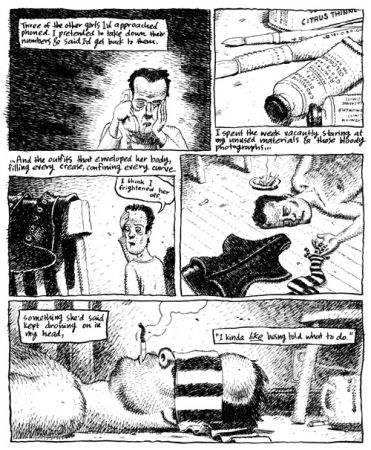
Martin, the narrator of our story, is an uninspired illustrator. After failed attempts at making underground comics, his entire existence has morphed into a cotton candy malaise as he spends his days illustrating facile children’s books for a post-Barney generation. Upon the notice of an unexpected grant award, Martin’s stupor of indifference quickly ends.

In trying to muster up any piece of inspiration, Martin decides that his grant will produce paintings for an exhibit tritely titled, “The Eroticisim of Homeliness.” What begins as a dull concept of trying to paint conventionally unattractive women in an erotic light spirals rapidly out of control when Martin meets his first model, Tina.

Tina, by no means, is a physically attractive woman. She has the grace of a boar. She is unkempt and slovenly. She has the most peculiar canines, almost like those of a dog. She is completely untamed.

Tina’s personality does not have much to allure either. She’s not quite the sharpest girl. She lacks manners. She lacks tactfulness. She lacks the ability to consider the feelings of others. She is completely hedonistic in her philosophy of behavior.

Regardless of Tina’s lackluster, almost grotesque image and persona, Martin becomes completely infatuated with her, in a suffocating and overwhelming way that he cannot understand. His obsession is both carnal and transcendent. He physically longs for her and simultaneously hungers for her love. He is completely enamored.

Ripple is the complete recounting of Martin’s obsession with his subject Tina and their resulting relationship: their meeting, their physical encounters, and their end. It is more than just a tale of an artist-subject infatuation; Ripple is a character study of Martin, the artist, in the confines of his vacuum of a world. As Martin becomes more and more enraptured by Tina, we slowly begin to understand his seemingly mysterious, irrational desires for her.

Prior to Tina, Martin’s life lacked any emotional dynamic range. He lived at a stasis with his art, with his apartment, and we can assume with his love life. Love was abstract to him, derived from books and poems and never from any human encounter. He lived a life of complacency, rarely emoting and experiencing the feelings that are unique to humans.

Consequently, in facing Tina, Martin’s stasis ended. With Tina’s purely hedonistic sensibilities, Martin finally experienced and felt the highest range of excitement, joy, and lust and the lowest embarrassment, sadness, and disappointment. Though Tina was not his normal, “type,” Tina’s inability to even be classified leads Martin to his first time to actually experience the full emotional range of a person in love and to achieve the concept of the Ripple, the sensation of a complete disconnection from reality and the entrance into a world of complete consumption of another person. The Ripple is the heightening of pure sensuality in a way that is completely incomprehensible unless you have experienced it. For him, the Ripple is a completely abstract concept at first and one that Tina mocks him for until the two finally enter the Ripple at the climax of their relationship.

Regardless of the outrageousness and possibly sensationalistic sexual encounters between Tina and Martin, Ripple is a study of the compromises we make in life and how they affect our perceptions and preferences of sexuality, a topic well discussed by Bertrand Blier’s Too Beautiful For You, a film where a wealthy car dealership owner has an affair with his homely secretary. In living a complacent life, free of any major imperfections or traumas, one’s irrational desires and tendencies get displaced. All of the paths it travels are unknown, but in Ripple and in Too Beautiful For You, it goes toward sexuality.

By the end of Ripple, for Martin, love is no longer a flowery concept, no longer an abstracted, holy, sacred concept. It is tied to the earth, tied to Tina and the reality of all of her imperfections. The book itself is his attempt to pull apart this phenomenon of his desire for her, but she is gone, leaving him with a new sensation, irreconcilable love and longing.

Martin is certainly not well. His encounters with Tina were definitely unsavory, but, he has now at least experienced something more human than anything else in his normal, pallid life and can perhaps return to illustrating children’s novels without such complacency and maybe, just maybe, can create something inspired. This book is at least a good start.

Ripple by Dave Cooper is available via Fantagraphics Books.


Bovine Ska and Rocksteady 10/29/14: Happy Halloween with King Horror!!!

Standard

This past week’s Bovine Ska and Rocksteady is one of our favorite shows of the year….the Halloween show!!!

The show featured songs with ghoulish, sinister themes and titles ranging from devilish reggae, duppy mento, dracula reggae, and zombie ska. There’s even an entire set of duppy themed reggae and a duppy story weaving through the sets! We started off with a set of “Satan” themed reggae, beginning with a new acquisition here at The Bovine Ska and Rocksteady, “Satan Side” by Keith Hudson and Chuckles which was released on DUKE in 1972 and was produced by Keith Hudson himself.  That opening set ended with a back to back version excursion from The Ethiopians on Matador, “Satan Gal” and “Satan Boy.”

Given that the Bovine Ska and Rocksteady almost always needs a spotlight, this show has a special one from the most terrifying reggae voice of all, King Horror!

King Horror-Frankenstein

This 1969 King Horror cut is pretty spooky!

Much of the fun of the King Horror spotlight comes from the question: Who is King Horror?

The real answer is that we have no idea, but we have a few suspicions. Across all accounts, the most likely answer is that King Horror was Lord Davey, who was produced by Laurel Aitken. Given the involvement of Laurel, there is some confusion surrounding who really performed on the King Horror tracks. On many of the tracks, it is clear that you do not hear Laurel‘s voice, which would confirm that King Horror is actually Lord Davey. But, of course to make the identity more puzzling, it is believed that Laurel Aitken actually did cut a few singles as King Horror, but the rest of the singles were Young Growler, a calypsonian named Errol Naphtah Davy who immigrated to London from Trinidad in 1961.

Given the name similarities, we could guess that Young Growler and Lord Davey are most likely the same person. While multiple sources point to Davy, there is another claim to the King Horror name out there. Joe Mansano, of Brixton’s Joe’s Record Centre, claimed that King Horror was one of his DJs known as Lloydie and Lloyd the Matador, not to be confused with Lloyd the Matador Daley. Lloydie was apparently not the best looking man, and consequently, Joe and his people began to call him King Horror.

Regardless of the identity, all of these King Horror tracks feature eerie sound effects, great screams, and amazing reggae rhythms.

Listen to the spooky edition of the Bovine Ska and Rocksteady HERE.

Enjoy! The archive will be available until 11/11/2014.

Generoso Makes Spaghetti Bolognese Much To Lily’s Delight!

Standard

This dish is a must in the Fierro household as Lily has admitted on many an occasion that she “could and will eat this several days a week without a complaint.”  This class Italian dish of course comes from Bologna and its first appearance is said to be around 1891.  Spaghetti Bolognese first made its appearance here in Somerville for Lily in 2011, and it has been a blast to make ever since.  It is a fast dish (taking less than 2 hours to make from prep to plate) and you will only need the following ingredients to make more than enough for six people: Two boxes of spaghetti, one pound of fatty ground pork, one pound of fatty ground beef, four large carrots, a can of tomato puree, a bulb of garlic, salt, pepper, oregano and olive oil.    No need to write this down, I will show you how to make this step by step below.  Let’s me know how yours has come out!  Music from Giulio Regondi’s “Etude no. 6” and then Tommaso Giordani’s “Guitar Sonata in Cm.”


Yaphet Kotto Gets More Than Whitey In Larry Cohen’s 1972 Debut Film, “Bone”

Standard
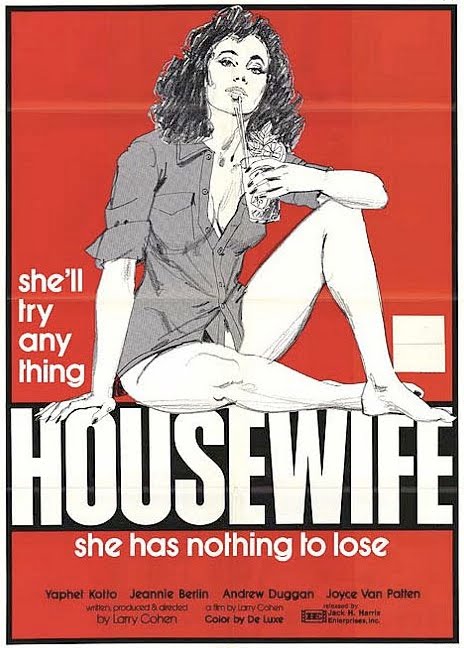
Bone-Housewife poster

One of the Many Titles of 1972’s “Bone”

OK, I admit it; I am a closeted Larry Cohen fan. I got my first taste of Larry Cohen’s handiwork when my friend Sam and I scored a VHS copy of the then notorious 1974 baby-killing-everyone-in-its-way film, “It’s Alive.” A film where a baby is born deformed and when the obstetrician tries to kill it, it goes all rip and tear on all who threaten it. Despite its bizarre concept, “Its Alive” was a sharp piece of satire on the abortion movement (Roe v. Wade was only a year earlier) and remains as Cohen’s most popular film as it did spawn (no pun intended) two more sequels. “It’s Alive” is not Cohen’s first attempt at directing a satire on the current state of American culture, his debut film “Bone,” would be Cohen’s opening and comedic salvo at an America rotting from the top down.

“Bone” begins with super car salesman, Bill Lennox (Andrew Duggan) pitching his wares which consist of mauled bodies in trashed cars during a fantasy television commercial sequence that clearly eludes to Godard’s 1967 classic, “Weekend.” I say this because reality kicks in soon afterwards, as we soon see a bourgeois Bill with his luxurious wife Bernadette (Joyce Van Patten) going through the motions in a faux paradise while Bill secretly knows that it is all a façade. And to make things worse, there is a rat in pool’s filter, a big black rat, and Bill isn’t going to fish it out and neither will Bernadette. What is there to do? Here enters our “hero,” Bone (Yaphet Kotto).

Bone first comes off as what Spike Lee would call, “a magical negro,” you know, helpful with a dash of subservience, like Harry Belafone in 1970’s “The Angel Levine,” but that doesn’t last long. Soon, “Bone” gets down to business as he has been spying on the Lennox’s lavish home and he makes the natural but incorrect assumption that there is a lot of cash waiting inside which is soon finds is not there.  Yes, the Lennox’s are mired in debt but after rifling through the Lennox’s home, Bone finds a bankbook and it seems that Bill has stashed away five grand without Bernadette’s knowledge.    Now Bill must go out and get the money from the bank or else Bone would take out his rage on Bernadette in a not too pleasant threat of rape and beheading.

For the rest of the film, Bill and Bernadette are apart and experience two different kinds of journeys. Bill is offered a loan from his bank as opposed to full cash withdrawal. Being that he now has this option, Bill doesn’t seem too anxious to get home and wanders through Los Angeles until he finds a bar where he meets the dentally obsessed boozehound, Brett Somers, of TV’s “Match Game” fame. They share a drink and a view at her ex-husband’s dental records until he tires and flees into the company of a random kleptomaniac, played by the biggest name actress in the film, Jeannie Berlin, who had just received massive kudos from her role in “The Heartbreak Kid.” They plunder a supermarket and Bill eats a stolen steak with our klepto at her fabulous pad as she goes on about her many schemes to get free products and money. Bill quickly learns that she is no less the conman than himself and they go at it quickly before Bill decides to split.

Bernadette meanwhile has the daunting task of entertaining Bone, and first she tries to do so with her best upper class whiles which do not sit well. She offers to cook for him and after that fails, Bone’s thoughts turn to sexual assault which at first repels Bernadette, but then after putting up a small fight, she agrees to the rape which immediately deflates Bone’s imposing mojo and he seems defeated. After a bit of talking out of Bone’s loss of “nigger mystique,” they both have consensual sex and team up to go after Bill, who they feel has done them both wrong. There is a lot in this segment that will not sit well with the political correctness of this era, but it doesn’t make its overall message wrong by any means.

Bill and Bernadette’s individual dystopian journeys in “Bone” are what set it apart from so many of the well-intentioned but flawed racial films of its era. “Bone” is mean and quite funny at times, but unlike films like “Watermelon Man,” it pulls no punches and really gets at white America’s fear of the scary, uncontrollable black man and its own decaying class imperative. It’s 1972 after all, and racial issues are still on the forefront of the press coverage, as is the war in Vietnam, which is handled here in another one of the Lennox’s lies as they claim that their son is a helicopter pilot in Vietnam who we eventually find out is just another rich white kid who skipped out on the draft and is serving time in Spain for smuggling hash.

“Bone” did not fare well at the theaters. It was originally distributed in suburban markets as a tawdry expose and titled “Beverley Hills Nightmare.” After that failure, it was repackaged for black audiences as “Dial Rat For Murder” and “Bone” which also didn’t work, so they splattered the poster with an image of the film’s only big name, Jeannie Berlin, and renamed it “Housewife” for a chance to cash in on her fame in the arthouse circuit, which unfortunately did not work either.

Don’t Let The Title Fool You, It’s “BONE”

This would hardly be the end of Larry Cohen, who would direct two fairly popular films in 1973 with blaxpolitation film legend Fred Williamson, entitled “Black Caesar” and “Hell Up in Harlem” before scoring his biggest hit with the aforementioned “It’s Alive.” Cohen’s critical masterpiece “God Told Me To” about a deranged serial killer who receives divine inspiration to murder would be a couple of years later. Most of Cohen’s later efforts would be less on satire and more on the pure horror side with films like “Q” and “The Stuff.”

Sometimes entertaining and always audacious, Larry Cohen is the kind of exploitation film writer and director that is so sorely missing from today’s films. The kind of nasty, uncompromising filmmaker who is needed to get out the true message of an America rotting from the head down.

Love and Faith and Growing Up in Craig Thompson’s Blankets

Standard

PREFACE: My dearest friend Samantha Fleitman brought up the graphic novel I am about to review two summers ago when she found out that I was beginning to delve into the medium. The seasons progressed, and I began to read more and more and constantly forgot to read Blankets. I must admit that it was somewhat due to the intimidating length, but that’s a lame excuse. Alas, on Friday, I determined that THIS was the weekend that I started and finished Craig Thompson’s Blankets, and it is thus the subject for this week’s review. Many thanks to Samantha for the recommendation!

Blankets Cover


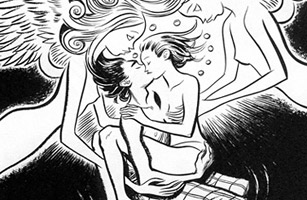
Released in 2003, Blankets is a bit older than what I normally review here, but given the relevance of its message and narrative, it is by no means a dated novel (after all, all of the 2000s seem kind of like a blur to me anyway). An autobiographical coming of age story for Craig Thompson, the creator, Blankets intimately follows Craig’s transition from a young boy to a young man. A hybrid of the Bildungsroman and the Künstlerroman, Blankets simultaneously weaves Thompson’s more abstract battles with his spirituality with his very Earth-bound battles with family drama, bullying, and love. In the process of mixing these two realms of conflict, Thompson’s persona as an artist and voice as a storyteller emerge.

Born to an evangelical Christian family, Thompson grew up in rural Wisconsin as an outsider, with his family’s lower middle class status and his mother’s extreme evangelicalism casting him as a pariah among his secular and Bible school classmates. The first eighth of Blankets gathers and develops the context of the creation of Thompson’s voice through non-linear moments from his childhood and adolescence. From a very early start, Thompson has a strong connection with the Bible and a complementary guilt complex nourished by his family and his conservative church. He is a quiet boy often picked on in school, and in turn, is often the catalyst for arguments at home with his brother, Phil.

After the introduction of young outcast Thompson, the narrative begins to linearize as a teenage Thompson meets Raina, his first love, at church snow-camp. As the other campers ski and snowboard, Raina, another outsider, and Craig ditch chapel hours and spend time getting to know each other. After the end of camp, the two begin their enamored long-distance relationship.

The blossoming and growth of Craig and Raina’s relationship dominates the rest of the novel, which seems like it could lead to boring or stereotypical comments and details about young love, but Blankets opts for a much different course. Thompson, in the narration of the relationship between him and his first love, ties in fragments of his childhood and moments of her childhood, building their relationship in a naturalistic, anti-hyper-dramatic, and even in an anti-sexual way. As their relationship progresses, Thompson builds Raina into a nearly saint-like character with the way he worships her for her natural beauty and poise in the midst of handling her parent’s divorce, caring for her mentally disabled older brother and sister, and nurturing her niece whose parents completely disregard. Mixed into all of the storyline of Craig and Raina are moments of Thompson’s reality as a soon to be high school graduate considering ministry school and as a young Christian who is perpetually connected and disconnected with the Bible and afraid of disappointing God, making this coming of age tale more layered than a basic story about a young person trying to deal with his or her current circumstances at home or at school.

By the end of Blankets, much of the original dogmatism of Thompson’s Christianity has eroded, with the method of the erosion being the grand strength of the novel. In the process of placing Raina up on a pedestal after spending two weeks with her in her home in Michigan, Thompson feels conflicted between earthly love with carnal desires and divine love with reverence of a superior, perfect being. In worshipping Raina,  his love for her is that of into divine love instead of love between two partners, making it almost too suffocating and overwhelming to Raina when the two are apart.

When Raina calls Craig to end their romantic relationship, he begins to attempt to reconcile the concepts of earthly love versus divine love which then transitions into reconciling religious fervor versus piety. As Thompson becomes enraptured by the book of Ecclesiastes, his faith moves away from the blinded, fervent devotion of a divine, infallible, omnipotent being who must be worshipped in the Church with song and ritual. Gradually, he begins to discover more of the gifts and powers of God through the earth itself through his admiration of all of God’s creation, with the understanding that it is all fleeting and transforming.

From this enlightenment of faith, Craig also realizes that his love for Raina is unsustainable and ends their friendship, for his abstract love for Raina prevents him from understanding how to love her as another fallible human being. In a moment of parallel symbolism, Craig destroys all of the gifts Raina had given him (with the exception of a quilt) that have become idolatry for him, paralleling his concurrent distancing from the church and the eventual hiding of his Bible. By placing God, Christ, and Raina on a pedestal of perfection, Craig is unable to fully develop his true sense of faith in God and love for another human, stunting his ability to make a decision to move forward with his life because he views himself as an inferior being. With the discovery of his faith and his understanding of his relationship with Raina, Craig makes the final change in his path with his decision to go to art school after graduation, a decision which he could not make because he once feared that going to art school would be sinful.

By the end of Blankets, Craig returns to his home as an adult, and re-discovers his Bible and his quilt. His faith no longer involves the devotion to a perfect being and the consequent fear of offending God, and in parallel, his thoughts of Raina become more bound to his experiences with her. By the end, Craig’s faith and belief stems from learning the teachings and actions of Christ on earth, reminding him that the beauty and admiration of Christ lies in his interactions with people, and not as simply an omnipotent deity in the sky. And simultaneously, the beauty of his relationship with Raina lies in their time together in each other’s company as human beings, and his admiration of her lies in her character’s strength in being able to gracefully continue with love and affection through a difficult time rather than her existence as a pure, perfect saint.

Blankets is a beautiful coming of age story that captures so much more than just a first love or a first major conflict. It weaves together multiple crises of familial, societal, and spiritual origin to allow us to comprehend how the growth and shift of our individual belief systems manifest into our actions and our relationships with the people and the world around us.

Blankets is available via Top Shelf Productions.