The Return to Noir Fundamentals in The Fade Out

Standard

It’s been over seventy years since film noir was at its peak, but the genre and its framework seems to never have left our culture, with iterations, updates, and transformations in films, novels, and of course, comic books. With so many new takes on the noir, it was oddly refreshing to read The Fade Out, a series that goes back to the fundamentals of this embedded genre.

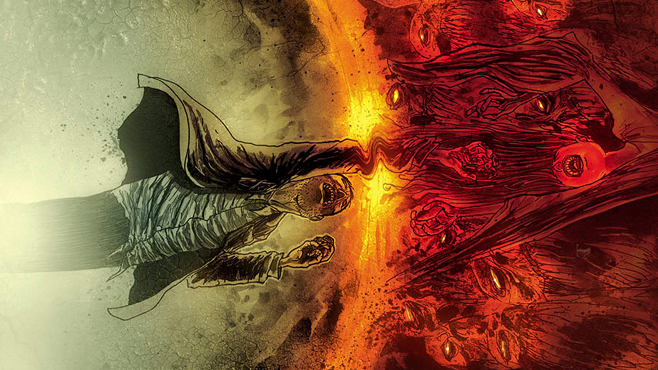
Issue One Cover

The Fade Out centers its mystery on the murder of Valeria Sommers (birth name: Jenny Summers), the young starlet on the course to becoming the next Veronica Lake. The year of our story is 1948, a year where all of America was on its toes. Pearl Harbor and World War II had put people on alert for any signs of physical attack, and anti-communist sentiments had people on alert for any signs of cultural attack. Despite the victory of World War II, America still had some paranoia about what major force will be faced next, and it looked like communism was it. With America on the brink of full McCarthyism, the industry that would feel the brunt of it, the film industry, had begun to experience the rising concern about communists infiltrating media.

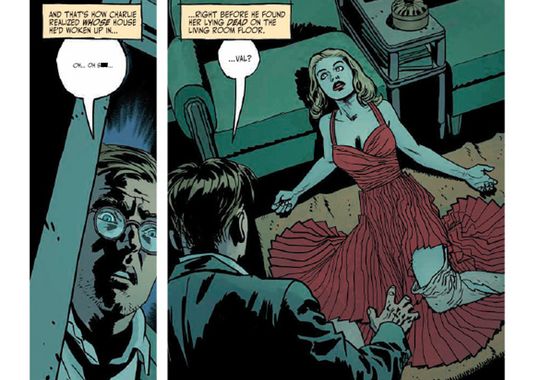
Set in the iconic noir location of Los Angeles, the narrative of The Fade Out is carried by Charlie Parish, a screenwriter for a studio on the edge of failure and the oddly lighthearted but very confused narrator of the series. Issue One introduces us to Charlie as he wakes from a drunken coma in an unknown apartment and tries to recollect the night before. As his blurred memories gradually become clearer and as he walks through the apartment, he realizes that he is in Valeria’s bed in her apartment and finds her murdered Valeria in the room next door. The discovery of her body incites panic in Charlie because it must have happened while he was asleep in the next room, but he has no memory of waking up to any disturbance. What entails is Charlie’s attempts to further recall the details of the party he attended and to wipe away evidence that he was at Valeria’s apartment in fear that he may be considered as a suspect. The main case to solve in The Fade Out is a pretty traditional one with a setup almost identical to that of Clue; we know the set of suspects, and we follow Charlie along as he tries to piece together each of their potential motivations to kill Valeria. On the murder mystery plot line alone, The Fade Out is motivating and attention-grabbing. However, what makes The Fade Out a series that I look forward to is its incorporation of the rich political and cultural environment of the late 40s.

Issue Two Cover

At the height of noir in America, films could not fully incorporate a wide range of subjects ranging from sexuality to political climate, and they certainly could not discuss the ugly details of the impact of McCarthyism on the film industry itself. With The Fade Out written in current times, the creators have the opportunity to enrich the noir story with relevant cultural and political topics affecting America’s film industry in the late 40s, and they certainly take advantage of this more open creative license.

In the core murder case, the details of the film studio’s actions to cover up the circumstances of Valeria’s death in order to avoid scandal enhance the narrative by leaving Charlie as the single person to acknowledge that Valeria was in fact murdered and as the only person left responsible to find her killer. In retrospect, we now know about film studios’ actions of megalomania and monopoly in the 40s and 50s, but in no way could those be addressed in the films made by those studios at the time–that would absolutely setup a conflict of interest. But given that The Fade Out is written today, those details of truth manipulation can now be included, making the setting and narrative more engrossing and setting up the onus on Charlie to find the perpetrator alone without the intervention of any law enforcement, making the perspective of the mystery even more alluring.

In addition, one of the most captivating sub-plots in the narrative is that of Charlie and Gil Mason, a story that could have never been addressed on film on the brink of McCarthyism. When Charlie entered the film industry, Gil served as his mentor, but after Charlie’s stint in the war leading to perpetual writer’s block and Gil’s communist sentiments preparing him to be blacklisted, Charlie and Gil become embroiled in a cover-up scheme that could only occur in the late 40s and could only be explained in a narrative written today. For me, Charlie and Gil’s tumultuous working and personal relationship drive the narrative and augment what would otherwise be a fairly standard murder mystery. Given the belligerent and oddly sympathetic nature of their actions, Charlie and Gil’s conversations and actions with each other emerge as the star component of the series.

As with any noir adaptation set in the 40s and 50s but written in modern times, The Fade Out contains more explicit details of sexual hedonism alluded to but never allowed in the films of that era. Unlike in Satellite Sam, sexuality does not exist as the core device of re-imagining the noir for The Fade Out. The update to the noir here really occurs through the integration of political and cultural artifacts and sentiments into the main plot and subplots of the series. The Fade Out sticks to the basics of the noir genre, but it rises above a classification as a noir duplication in its ability to use history to make a period piece come alive and engage readers who are almost three quarters of a century removed from the original setting. It may not be the most groundbreaking series, but for those who like history, mysteries, and noir, The Fade Out, with its earliest issues, seems to have potential for strong narratives and fascinating characters and relationships.

The Fade Out Issues One and Two are available now via Image Comics.

Hawkeye vs. Deadpool, the Unlikely Couple to Save the World

Standard

This week, when I traveled to my local comic book shop, I was thrilled to find the newest issue (#20) of Hawkeye. For me, Fraction and Aja’s take on Hawkeye was my entry point into the world of graphic novels and comic books, and it is a series that I perhaps hold a little too dearly to my heart. Sadly, my excitement faded when I found out that the issue was a Kate Bishop one rather than a Clint Barton one (especially after #19 which is almost entirely written with sign language). I’ll cut my criticisms short on the Kate component of the Hawkeye series and just say that the narrative for Kate’s story arc is lackluster and pallid compared to that of Clint’s.

In light of my disappointment, a neighboring series caught my eye because I am now programmed to take a look at anything that has the name “Hawkeye” on it. Hawkeye vs. Deadpool is a new Marvel cross-pollination hero series, with issue zero released in September and issue one released in October. Superhero collaborations, be it two heroes or teams of heroes, are always a little dicey. Like greatest hits albums, which will often only include the most popular tracks and only show one side of an artist, superhero collaborations often lose the nuances and the intricacies of the characters involved and end up showing only a more polished version of the skeleton of the main subjects. However, the best thing that a summary/compilation album can do is introduce you to the fundamental core of an artist and encourage you to explore beyond. Similarly, collaboration/crossover narratives in comic books can do the same, and Hawkeye vs. Deadpool is one of those superhero combinations that facilitates the desire to dive deeper into the individual characters involved.

Artwork for Issue Zero Cover

Artwork for Issue One Cover

Hawkeye vs. Deadpool introduces us to Clint Barton’s and Deadpool’s vastly conflicting personalities and tactics as superheroes, with Clint as the semi-diplomatic and semi-reasonable member of society and Deadpool as the brash and semi-caustic mutant. Both have senses of humor that also acutely reflect their personas, making their interactions with each other the bright star of this series. The action part of the story focuses on the two trying to prevent a S.H.I.E.L.D. hacker from causing harm, but the real meat of Hawkeye vs. Deadpool lies in their uncanny working relationship; the two oddly have a similar relationship as Peter Falk and Alan Arkin in The In-Laws (1979), with Hawkeye resembling Sheldon, the mild-mannered dentist, and Deadpool resembling Vince, the impetuous businessman and possible CIA agent. Both pairs are in desperate situations and must rely on non-ideal partners to try and save the day. Consequently, in their bickering and in their comedic moments of miscommunication, Hawkeye and Deadpool, like Sheldon and Vince, become characters that you care for, cheer on, and want to learn more about.

Don’t expect an insightful commentary on humanity through superhero metaphors from Hawkeye vs. Deadpool, but do get excited for its silliness and its pure entertainment and comedic value. Though not a masterpiece, Hawkeye vs. Deadpool achieves what it sets to accomplish: a fun integration of two unlikely heroes and personalities. In addition, I am not familiar with the new Deadpool series, and I am now motivated to read it, which makes Hawkeye vs. Deadpool all the more successful in its endeavor.

Hawkeye vs. Deadpool issues #1 &2 are now available via Marvel comics.  

It’s Fall! It’s Time For Che Bap!

Standard

In this week’s cooking video, Lily shows you how to make probably one of the easiest dishes she makes, Che Bap.

Che Bap is a dessert made with corn, coconut milk, tapioca, and sugar. It’s a very easy warm dessert that can be made in a large batch. The Fierro house often eats it in the fall and then hides away from cold weather.

Enjoy! Music provided by Niccolò Paganini’s Violin Concerto no. 1 in Eb, Op. 6.

The Myths of the Afterlife with Ten Grand

Standard

In anticipation of its second volume’s release next month, for this week’s graphic novel pick, I selected the newest series by the comic book and graphic novel veteran, J. Michael Straczynski, Ten Grand.

The Intriguing Cover of the First Volume of Ten Grand

Following last week’s trend of super agents/guns-for-hires of organizations, Ten Grand is the story of a former mob contracted enforcer, Joseph Fitzgerald (who is referred to as Joe in the series and for the rest of this review), who took his last job to get out of the life and ended up in a contract much more difficult to maintain and handle than that of his severe mob boss. Joe is the hired agent of Heaven, kept on earth to do what he is asked to and resurrected from death in order to continue to do anything and everything Heaven requests.

Oddly enough, Heaven’s tasks for Joe are not as easy or as peaceful as one would expect. In fact, the contract exists because Joe could only choose between separation from his beloved wife, Laura, with eternal damnation in Hell or long-term separation from Laura by remaining on Earth as a perpetual agent of Heaven, with the benefit of 5 minute breaks to see and spend time with Laura in the time window between his noble death on the job and his resurrection to continue his now destined work. Given the darkness and evil of Joe’s past, his contract requires him to dig into the darkest, most decrepit corners of humanity and the edges of Hell. In order to repent for the sins of his first life, Joe, in each of his resurrected lives, must do the dirty work of Heaven: tracking the work of the devil and preventing the devil and his demons from taking over Earth.

In his spare time, beyond the jobs requested by Heaven, Joe works as a private investigator for people in the most dire situations for a fee of $10,000, thus giving us the title of the series. The first volume of Ten Grand begins with the job to find Sarah Thomas, the sister of Debbie Thomas, a woman who hires Joe for the job. Sarah joined a new demonic cult known as the Divine Will, and her sister Debbie is very concerned about her whereabouts since joining. At first, the request seems like an easy one, but it quickly spirals out of control when Joe realizes that the leader of the Divine Will, Brother James, is an agent of the devil’s demons and the man who he had killed previously in order to avenge Laura’s death.

The job to find Sarah eventually transforms into the personal quest to find and destroy Brother James. On the surface, Ten Grand is a story about vengeance, but as the narrative unfolds, we embark on a modern spin on a mythological battle between good and evil with an expansion on the worlds of Heaven and Hell and all of the planes in between. In the tradition of mythology, we meet many archetypal characters, ranging from the blind prophet to the guardian angel. And in the same tradition, there is cryptic symbology and an understanding of the abilities and difficulties to pass between the different dimensions of existence.

Though Ten Grand contains the supernatural forces and events expected in any mythology, its elements of realism make it captivating and relatable. The characters in Joe’s reality on Earth are by far some of the most interesting. One of them is the spirit of a woman who committed suicide but has not left Earth because she is too attached the the memories in her home; she communicates with and longs for the company of Joe, who was one of the first people to try to understand her spirit’s cries after her death. Another is a coroner at the local morgue who interacts with Joe as if he were a regular customer. Another is Lenny  (who we barely meet), the bartender who allows Joe to run his private investigation business in his bar. Like any good mythology, Ten Grand blends the supernatural with the real, with both worlds containing fragments of each other, and making the narrative seem like it is not to far from our own reality.

Beyond the characters and the pretty awesome premise, what I think is the most interesting about Ten Grand is its discourse on salvation and damnation and what happens if your fate does not include either one. With the help of the artists Ben Templesmith and C.P. Smith, Straczynski presents multiple options for those who cannot be sent to Heaven or Hell. There are some who are determined travelers of the planes like Joe. There are messengers of the planes like the spirit who remains at the home she died in or the blind prophet, Johnny. And there are others who are stuck in purgatory, those whose souls are lost and do not belong.

Ten Grand is an original, imaginative modern mythology, with thought-provoking criteria for existence in the different levels of afterlife. In an enlightening discussion with the boat guide on what looks like the River Styx, we find out that those who are in purgatory are those who betray their hearts and suppress their souls in life. According to Straczynski’s myth, the people who remain in purgatory are those who have eroded their souls by the time they die: the people who concede to what is expected of them without thought and the people who live lives determined by other people, or in other words, the people who settle and become complacent with lives they do not want. Ten Grand is a fascinating story about a very flawed man who lives an almost futile existence, but in its narrative paths, it allows us to ask ourselves who we want to be, what afterlife we hope to reach, and how we should and should not act to try to get there.

Ten Grand is available via Image Comics. Volume One was released in January 2014, and Volume Two is set to be released on November 12, 2014. 

How to Make Lily’s Version of Cantonese Tomato and Egg

Standard

Tomato and egg is a very pedestrian dish that is a common quick bite in the Fierro House. Lily grew up eating it right after school with rice, but as an adult, she began to make her own version with thick rice noodles (mostly only because she is a noodle fiend). Lily’s version incorporates the egg into the tomato, which is different from the traditional stir fry. See how to make this simple, yet satisfying dish! Enjoy!

Music courtesy of Joseph-Maurice Ravel’s Ma mère l’oye

The Unoriginal Life of Edward Zero

Standard

Edward Zero is the “Agency’s” former best secret operative whose life in 2038 is at the hands of a child operative from the agency in which he was once the shining star. As he speaks to the child, he begins to explain his story about how one of the world’s best agents fell from grace. From chapter to chapter, we see many of Zero’s missions, ranging from returning a stolen bioweapon in the Gaza Strip to eliminating a former agent who is now the leader of a nonviolent community in Brazil. Along the way, we meet the people in Zero’s life: Zizek, his trainer and mentor, Mina, his childhood love, Cooke, the new leader of the agency who is highly suspicious of Zero, and Ginsberg Nova, a masked man who is known as the leader of global terrorism who claims to know and remember Zero.

Zero Volume 1: “An Emergency”

What ensues in Zero Vol. 1: “An Emergency,” is a relatively standard story of a rogue agent of the CIA or some fictional secret operative agency that is supposed to represent the CIA. For the most part, each checkpoint in Zero’s escape from the agency is fairly predictable; Zero begins to break away from his stoic, machine-like, humanity-void countenance and protocol when he experiences emotional trauma. The first break happens when his love Mina is killed. The second break happens when he has to kill another rogue agent. Then, the major break happens when he simultaneously begins to ask questions about his parents, whom he cannot remember, and also realize that his agency is responsible for some bio-hazard material that has transformed people into lumpy, blob-like beings that look a little too much like a hybrid cross between Samantha Eggar in David Cronenberg’s The Brood and the pustule-laden  Baron Harkonnen in David Lynch’s Dune.

I reference these two films because the blob creatures are only a minor example of a sad and disappointing trend in the Zero series: watered down motifs, plot devices, and characters taken directly from films. As a graphic novel, Zero is not entirely a failure. As I read it, I was moderately interested and was at least motivated enough to complete the volume. And from a visual perspective, there is some stunning artwork in the series, with each chapter illustrated by a different artist in order to add visual segmentation of the different phases of Edward Zero. However, upon completing the reading, I had an overwhelmingly unsettling feeling that what I had just read was a graphic novel reconstitution of pieces of films. After spending some time talking to Generoso about the volume, three films came up in our discussion: the Bourne trilogy, The Conversation, and Three Days of the Condor.

Zero takes plot devices and themes from these films and fails to do what they all do so brilliantly: create suspense and an overall feeling of cynicism toward the agency one is part of while creating a sympathetic central figure that the audience hopes will succeed. Like the Bourne series, the narrative of Zero has a semi-paternal relationship between Zizek (the trainer) and Zero, the agent/trainee. In addition, Zero begins to go rogue as he begins to question about his past which has been wiped from his memory, which is the identical to the motivations of  Jason Bourne when he goes rogue. Like Joe Turner in Three Days of the Condor,  Zero falls from the top of the agency when he gains prohibited knowledge of a secret operation. And, like Harry Caul in The Conversation, what leads to Zero’s end is what he was himself.

Okay, so sure, as long as the story was engaging, I should not take too many points away from the graphic novel. But what makes Zero an unsatisfying read is that not only did it mimic narrative branches from some excellent films about espionage and secret operations but it also failed to combine these duplicated devices in a way that created suspense or allowed me to connect with Edward Zero as a character. Despite the small moments of human emotion that we see in Edward Zero, there is little to motivate the reader to sympathize with him and to desire to see him accomplish and triumph, which I feel is essential in any narrative where anyone leaves an affiliated organization and former friends and colleagues become enemies.

By the time I completed the first volume of Zero, I felt that I wished I had seen a film instead. There are intricacies in the espionage genre that just were not captured in Zero, despite the fact that it used material from some impeccable sources. Consequently, the failure of Zero as a graphic novel is even more upsetting because the story is both unoriginal, with identifiable pieces from other older material, and dull, failing to capture the paranoia, the suspense, and the constant desire to see the protagonist triumph over corruption and evil that make a betrayal, rebellion, or fall from grace story thought-provoking and alluring. Zero combines multiple motifs and themes used in the espionage genre, and yet, is unable to execute any one of them completely and successfully.

Zero is written by Ales Kot and is available via Image Comics.

The Mythology of The Sixth Gun

Standard

As many may know, I really love westerns.

They seem to always have a paradoxical moral simplicity and complexity. They almost always have a protagonist with questionable motivations. And yet, the good almost always triumphs the evil, leading to an overwhelming catharsis for the reader or watcher (depending on the medium). Consequently, the simplicity of the fundamental structure of the basic western lends itself to transformation and evolution without losing its core.

After spending some time looking around for the next series to read, I found this list from IGN. Yes, I was a little weary of the source, but I figured I’d at least try to read something that other people are talking about. After scrolling through, I settled on The Sixth Gun, a western set in Reconstruction era America.

The Sixth Gun Vol. 1 Cold Dead Fingers

The Sixth Gun is an excellent example of a successful transformation of a western. It has the archetypal characters and themes of a western with new layers of horror and the supernatural that could only occur in the comic book, rather than film, form. Cullen Bunn and Brian Hurtt, the creators of the series, realized that despite their inability to mimic the epic film landscapes and the tense duels in the comic book form, they had the ability to add fantasy elements that could not be captured in any old western films. While The Sixth Gun adds innovative ideas and characters to the basic structure of the western, it also pays homage and reverence to a genre that the creators clearly love.

At the opening of The Sixth Gun Vol. 1 Cold Dead Fingers, we meet the sinister looking Mrs. Hume, a widow of the former Confederate General Oleander Bedford Hume, as she speaks to Pinkerton detectives she has hired to find her husband and some of his possessions. After that very brief introduction, we meet Drake Sinclair, a man dressed like a Pinkerton, as he approaches the prophetic spirits of the Gallows Tree (a really interesting take on the hanging tree motif). Sinclair is looking for some treasure and the spirits of the tree send him to the home of the Montcrief family. From the introduction of the two story branches, we immediately get the sense that Mrs. Hume is going to be our force of evil and Sinclair our flawed and seemingly dubious protagonist.

The story then jumps to the Montcrief farm, where Becky Montcrief, is taking care of her ill father. As her father gives her instructions on how to live after he has passed, he hands her a box and asks her to get rid of it in a place where no one can find it. As he begins to explain why, a crowd approaches the farm, and a shootout begins. The Pinkertons have arrived, and they are looking for the contents of the box, a gun with a small red symbol brandished on the ivory handle.

After, one of the Pinkertons kills the father, Becky picks up the gun and immediately faints. When another man tries to pick up the gun, and it burns him with a green fire, we immediately understand that the desired gun has supernatural powers that must be valuable to Mrs. Hume. When Sinclair arrives at the scene and recognizes the father Montcrief, he gets details about the goal of the Pinkertons from a dying man shot in the gunfight, galvanizing the plot.

The setting then abruptly shifts to a mission with a group of priests preparing for a brutal fight. When an army of ghouls arrives at the mission, they demand for the body of their leader, the former General Oleander Hume. After a bloody battle between the army and the fathers of the mission, the General is excavated from a well, and his ghost-like, demon form awakens and immediately demands his gun.

As the plot continues, we slowly find out more about the goblin General Hume and his army of the undead. We also learn more about Sinclair, who is much closer to Hume’s nefarious army than expected. Most interestingly, we learn about the gun that we are introduced to in the Montcrief home; it is one of a set of six guns which never need to be reloaded and each grant a specific power to the owner.

With one gun in the hands of Becky Montclief and the other five in the hands of Hume’s leading commanders, the complete powers of the collection cannot be harvested by General Hume. On one branch of the narrative, we follow Hume’s hunt for his gun. On the other branch of the narrative, we travel with Becky Montcrief, who is taken under Drake Sinclair and another bounty hunter, Billjohn O’Henry’s wing, on the quest to find the General’s treasure at a fort with a pit leading to the mouth of hell.

The rest of the first volume of The Sixth Gun follows the cat and mouse chase between General Hume and Sinclair. In the process of the chase and the clashes, we meet an incredible spectrum of characters ranging from a giant bird demon who guards the valleys in the canyon to soldiers of the dead killed by Hume who emerge as sand figures. As we encounter each of these fantastic characters and creatures, each one becomes a landmark hurdle and counter forces marking the course of our protagonists’ odyssey.

While the plot sounds like one engulfed in fantasy, The Sixth Gun is not exactly a fantasy or mystical western. Throughout the narrative, buzzards reappear as the storytellers of the supernatural events and as the guides in the transition from one’s current life to the afterlife. Given that the buzzards are often the last witnesses to a disastrous event, they are able to give the final words about life on Earth and are the only ones who are left to explain all of the secrets of our existence. The buzzards serve as a chorus to the odyssey, revealing the mythology approach of The Sixth Gun.

What is great about The Sixth Gun is that it a western Homeric odyssey, with myths conveying a spiritual reverence for nature, an understanding of the thin line between the present life and the underworld, the manifestation of evil, and the plight of hubris. It is a western at its heart, but it also provides an insight into the face of evil and how to avoid and escape it. The Sixth Gun is able to use elements of the supernatural without straying too far from reality, and by the end of the first volume, we are able to step away with a myth about decline of General Oleander Hume from his hubris and the triumph of Drake Sinclair when he finally understands courage, humility, and self-sacrifice.

The Sixth Gun Volumes 1-6 are available via Oni Press. 

Experimenting and Challenging the Form: “3 New Stories” by Dash Shaw

Standard

There’s always something alluring and overwhelming when you look at the consignment comics section at your local comic book shop. There’s always so much to pick from. There’s a horror comic in one section and a comic about a local coffee shop in another. There’s a plethora of comics about various incidents, supernatural or natural, that we may encounter in life. And, to make my decision more complicated, there are often books with covers and artwork that are almost too interesting to pass up.

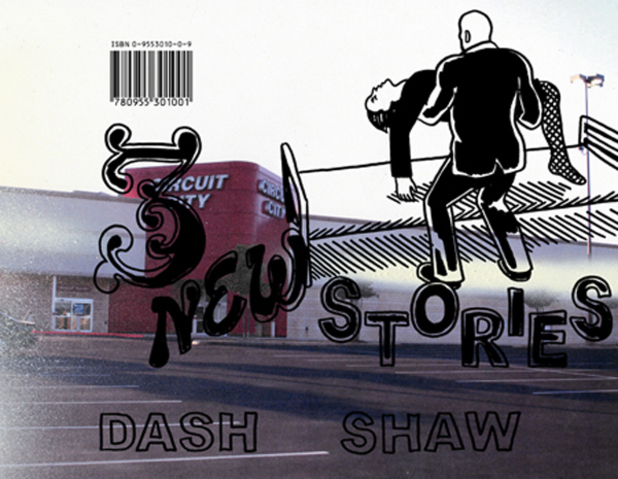
The last time I was at my local comic book shop (Hub Comics in Somerville), there was plenty to pick from. After opening and browsing through many of the shelves, I stumbled upon 3 New Stories, a small book with a stunning cover and early pages that motivated me to pick it up.

Back and Front Cover of 3 New Stories

3 New Stories, as the casual title suggests, contains a collection of three stories in three separate realities. All of the stories take place in a surrealistic, absurd America oddly reminiscent of the Springfield of The Simpsons in the 90s and frighteningly not too far away from our current reality. The first story, Object Lesson, introduces us to an anachronistic private investigator who loses his job and finds himself back in high school to finish his diploma, which he possibly did not complete due to a technicality. The second story, Acting is Reacting, briefly introduces us to the depressing, decaying world of Girls Gone Wild. Lastly, the final story, Bronx Children’s Prison, follows the life and the attempted escape of the prisoners in the Bronx Children’s Prison.

3 New Stories is really quite difficult to review. From a text based narrative perspective, Object Lesson is by far the most successful. It’s clever, funny, and surprisingly absurd. It also makes an interesting statement about how American businesses and con men prey on people through nostalgia when they get older. It also makes an implicit statement about how the American economy is very coldly and inhumanely throwing out its older workforce. Most impressively, both of these large statements are made in a matter of a few pages. In contrast to the strong text narrative of the opening story, the next two were a little disappointing and lackluster by comparison. Acting is Reacting from a pure narrative perspective falls pretty flat, and Bronx Children’s Prison is a pretty basic prison story, despite the young age of the prisoners and an element of fantasy.

However, there is a separate layer to address with 3 New Stories: its artwork as its major storyteller.

3 New Stories has some of the most daring and innovative artwork to appear in the comic book/graphic novel arena. It pays homage to the traditional flat black and white style of most comics while adding layers of exceptional texture from watercolor and paint. And from the interesting art techniques, 3 New Stories emerges as almost, dare I say it, an experimental comic book.

Given the strength of solely the text narrative of Object Lesson, the artwork is used to enrich the tone of the narrative. There are streaks of sickly olive green and rust in the backgrounds, enhancing the misery and the direness of the older students in the high school and conveying the sinister nature of the people who are running the high school. There are disjointed panels and floating images that emphasize the disorienting world the private investigator is experiencing. Here, the combination of non-traditional artwork and basic text narrative construction is at its best, demonstrating the epitome of what the medium of graphic novels and comic books can be as a storytelling form.

For Acting is Reacting, which probably is the most bizarre of the bunch, the artwork takes the stage in front of the story. While the panels of the narrative show how a Finnish girl ends up in a Girls Gone Wild video, the background artwork of maps of parts of Texas seems to be suggesting the endless roads traveled by the Girls crew to film their clips. The endlessly branching roads and the numerous letters of towns give us a sense of the monotony of the whole Girls enterprise. The Finnish girl on the panels is no more than one girl one town on a map of thousands of cities, towns, and roads. In this second narrative, the background artwork far overpowers the narrative in the panels in its ability to add layers to the storytelling, but the two nevertheless interact and project onto each other in order to form a richer and certainly more interesting story with very few words and interpretive liberty for the reader/watcher.

As for Bronx Children’s Prison, the artwork overpowers the narrative given by the text in a way that almost feels like a successful experimental film montage. In a story about children taking over and escaping a prison, there are elements of clear fantasy, and these moments are separated visually with overwhelming dots of color, evoking the feelings of a dream or hallucination. However, in the story there are moments of realistic consequences, and here, the dots are absent, leaving the reader with only sparse black and white forms. While this last story is probably my least favorite of the collection, the use of the oversaturated, overwhelming images to demarcate states of fantasy versus reality adds a layer of complexity to the narrative that had me motivated to finish the story.

3 New Stories, though flawed, is an excellent representation of how the comic book and graphic novel world can expand and challenge its boundaries. As a passionate fan of both literature and visual art, I have always felt that graphic novels have the advantage of an enormous range of visual, non-verbal techniques to tell a story. Consequently, graphic novels and comic books have more opportunities to create richer settings, to convey complexities in mood and tone, and most of all, to communicate nuances in a character, all of which Dash Shaw attempts to do in 3 New Stories.

Of everything I have written about, please do check out 3 New Stories. While it may not be the epitome of the full fruition and realization of the comic book and graphic novel media form, it is much closer than many (if not most) of its peers. And even though I admit that the text based narrative composition is lacking, I must commend its willingness to experiment with the combination of verbal and non-verbal storytelling. As much as I love more traditional forms of comics and graphic novels, I was excited and thrilled to see and read something that is trying to reach far beyond its own expectations as a storytelling form.

3 New Stories was created by Dash Shaw and is available via Fantagraphics Books


Shake! Shake! How to Make Dau Hu Luc Lac

Standard

In this week’s episode of cooking at the Fierro home, Lily shows you how to make Dau Hu Luc Lac, one of her favorite vegetarian dishes.

Luc Lac is traditionally made with beef, but the Fierros often eat the tofu version.

Watch as Lily shows you how to transform blocks of tofu into Dau Hu Luc Lac, which actually translates into “Shaking Tofu.” This dish is traditionally served under a simple salad and a side of rice, but you are welcome to serve it any way you would like!

Music provided by Francesco Geminiani and his Concerto Grosso No. 2.

Bovine Ska and Rocksteady 9/3/2014: The West Indians

Standard

We had a lot of fun putting together with last week’s Bovine Ska and Rocksteady because we were armed at the beginning with a great 7″ from Lloyd Charmers on the Green Door label from 1973 entitled, “Save the People.” We followed up that track with another seven tasty early reggae recordings from 1969-1975, including great ones from from the magnificent Scotty and the triumphant King Stitt.

For the spotlight of the September 20th edition of the Bovine Ska and Rocksteady, we featured the rocksteady and reggae recordings from the beautiful trio known as The West Indians.

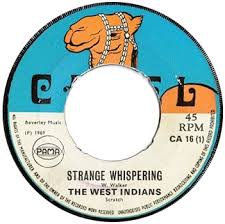
Strange Whispering on the Camel label - 1969

Strange Whispering on the Camel label – 1969

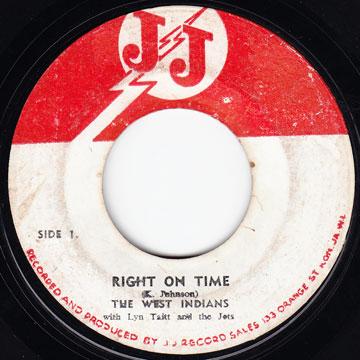
The West Indians were Leslie Burke, Hector Brooks, and Eric Donaldson. Not too much is known about Leslie Burke or Hector Brooks, but we do know a bit about Eric Donaldson. Born in 1947 in St. Catherine, Eric Donaldson originally recorded for Coxone, but, as with many other artists, Coxone decided not to release any of his recordings. After this first stint at a solo career, he joined Burke and Brooks to record as The West Indians. During their career together, The West Indians scored a minor hit in 1968 with, “Right On Time.”

Then, in 1971 Eric Donaldson released, “Cherry Oh Baby,” which won the festival song competition that year, launching his solo career. Consequently, The West Indians would exist as a vocal group for another year until 1972, when they parted ways. The West Indians best recordings happened with JJ Johnson and Lee Scratch Perry, and the spotlight began with two of their rocksteady tracks released on President in 1967.

Listen to the full spotlight and the show via the WMBR archives here: LISTEN NOW

This link will be active until 9/16/2014. Enjoy!